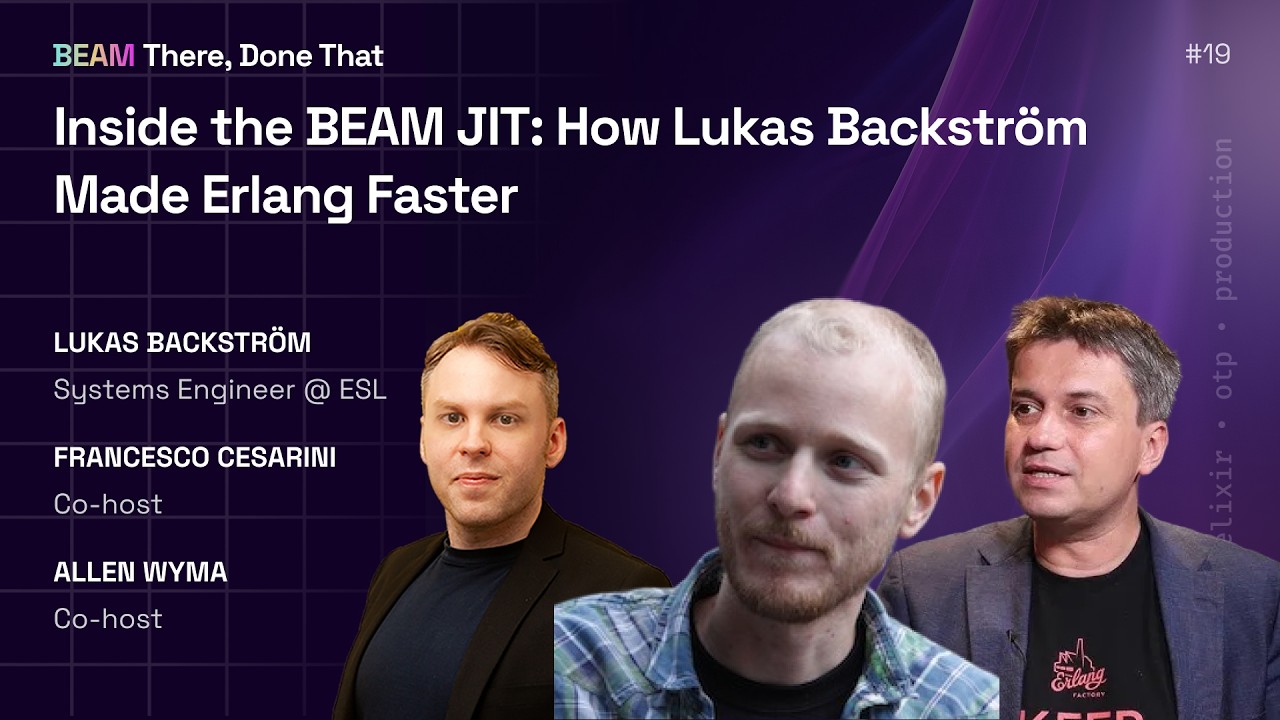
Sharing a recent BEAM There, Done That episode that covers the BEAM JIT in more technical depth than I’ve seen elsewhere. Lukas Backström, the OTP engineer who built it, walks through the full story from the first experiments to the current state.
A few things worth knowing for the Elixir side of the community:
The JIT benefits Elixir code directly - all BEAM code goes through the same JIT regardless of which language produced the bytecode. The optimizations are at the level of BEAM instructions, not language-specific constructs.
The current frontier is type-guided optimization. The Erlang compiler has become significantly smarter at type analysis, and that type information is embedded as metadata in compiled BEAM files. The JIT reads it at load time and can eliminate type guard checks when types are already proven. A simple integer addition on known small integers now compiles to a single assembly instruction rather than a sequence that checks types, handles big integers, and so on. This benefits code that’s type-annotated or has types that are inferable - which increasingly includes Elixir code as the type system work from the previous episode matures.
Lucas also notes that the JIT is genuinely readable. You can dump the assembly it generates for any module and the template-based design makes the translation from BEAM bytecode to native code relatively easy to follow. The native records implementation (currently in progress) is the best current example of how changes propagate through every layer: compiler, loader, JIT, runtime.