Update: I’ve been able to add Absinthe Telemetry events to the tracer, per reply above from @benwilson512 . Below are some observations and pretty pictures. I’ve tried to keep the same query here from the original post, for some apples-to-apples comparison. Hope this all helps.
- You’ll notice there’s a significant reduction in speed. The query document remains the same, along with the response size, more or less (if anything, the response is likely bigger). Part of this is attributed to some logic/DB work we’ve been doing underneath the query, and some of it is directly attributed to the
.uniqissue I mentioned earlier. Hope that helps anyone else with looking to increase performance.
Overall shape of the query. The first flame of spans is the context loading, followed by the operation.start event, followed by the first resolution.start event. We’ll zoom in subsequent screenshots, but there’s a significant gap between those two events, and after the operation.stop event.

Context to Operation Start. There’s a miniscule gap (≈300µs) between context being added and the operation starting, but not significant enough for us to blink.
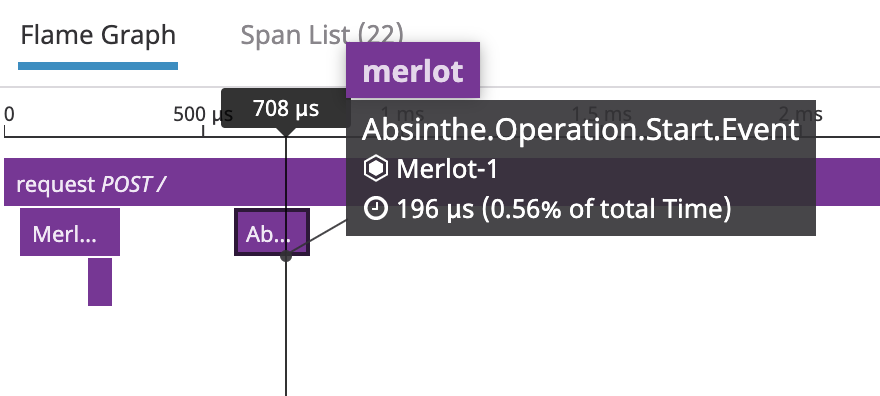
Operation Start. The span on the right of the screenshot is the first resolution.start event, which is followed by the fetch_messages query in the overall screenshot above. Would we expect there to be a ≈6ms delay or so between operation start and resolution start?

Operation Stop. There’s a ≈10ms gap after operation.stop that’s unaccounted for. I’ll dig into what could be happening there (perhaps other plugs?). I don’t assume so there’s any cleanup or anything that Absinthe would be doing after the operation, is there?

Edits
Maybe a clue, or could be a rabbit trail: it seems that the delay to context matters whether or not it’s a query or mutation. The gap from trace start to context being added is much less for mutations.- The above is a rabbit trail. Doesn’t seem to be anything deterministic causing the delay before Context gets called.