Yes, still actively working on this!
The current version of Journey works great, so I’ve been focusing on building and running applications with Journey, and planning and making iterative improvements (performance and scaling, dev ergonomics, refactoring).
I wish I had more time for examples and blog posts on this, but I did put together an example LiveView “Food Delivery” application, “JourDash” (sorry;).
You can run some “food deliveries” here: https://jourdash.gojourney.dev/
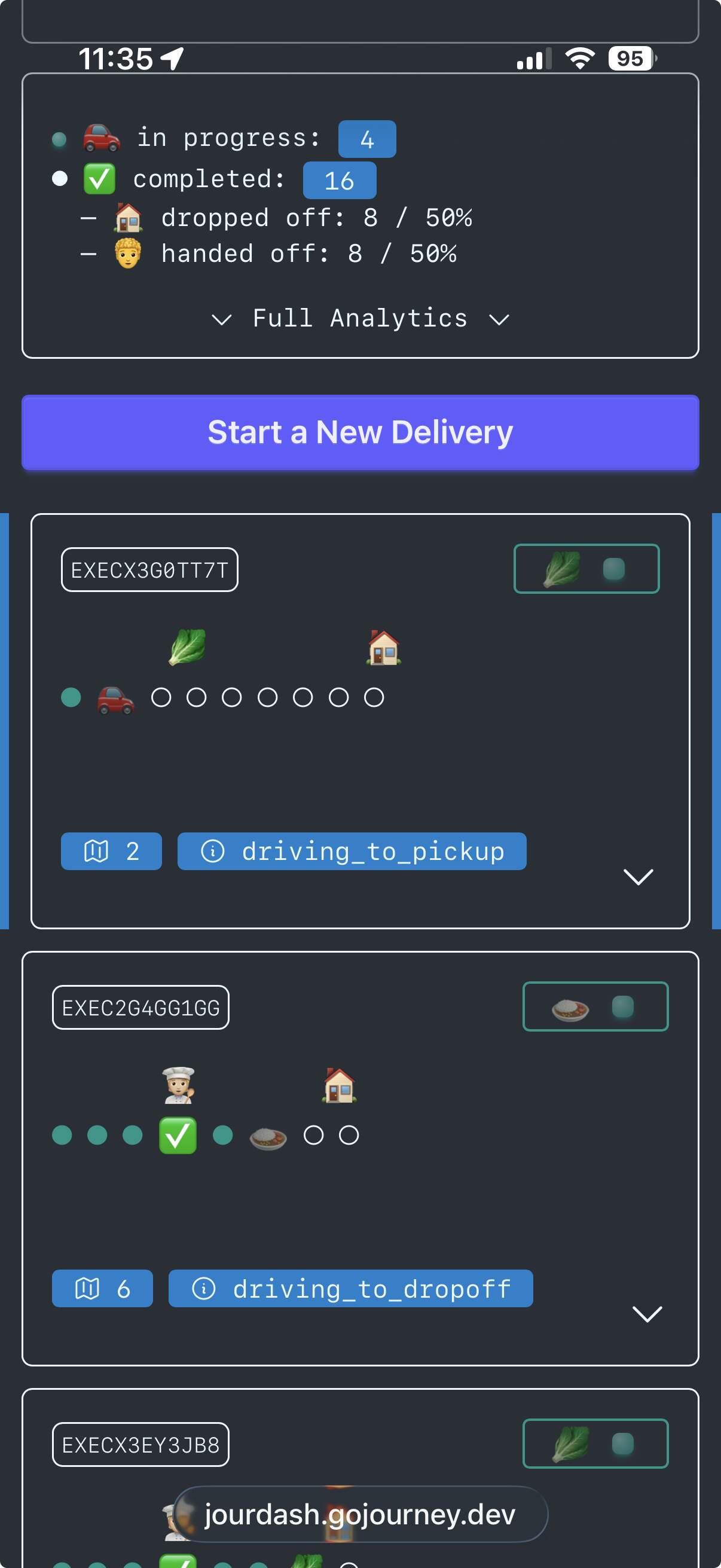
Journey does most of the heavy lifting in this application (the workflow engine, durable executions, persistence, scheduling, retry logic, basic analytics). So the code in the application is mostly just
- the definition of the graph and its computations +
- a bit of code running executions of the graph,
- the UI code. <<<< this is most of the code.
You can see the graph in JourDash’s github repo: jour_dash/lib/jour_dash/trip/graph.ex at main · shipworthy/jour_dash · GitHub .
As a side note, funny enough, LLMs seem to be great at looking at Journey graphs and answering questions like “What is this?”, “What is the business logic implemented by the graph?”, “What does Journey provide in this application?”, and “How much code would the application need to implement without Journey?”
If you are thinking of building something where Journey might be a good tool, I am happy to help (or help brainstorm)! Also, super-interested in feedback, ideas, suggestions for improvement.
PS And I did put together a goofy example of making a Useless Machine with Journey: Building a Useless Machine in Elixir - DEV Community