Why AI dream is a non sense and will die

(I just needed to vent somewhere and LinkedIn is full of hope, or hype, I’m not sure which exactly)

AI dream has many faces, but generally speaking it’s a new way to automate stuff, to replace those expensive, slow, ever complaining humans with cheap machines to maximize profits. You can also say it’s the next phase in never ending cycle of internalize/externalize your workforce that we all know. Companies were full of employees before AI came, and notice how many people were lay off in hope they can externalize the work to AI.

Why is the dream that, though?

It’s not about how expensive AI is to run, if the models are good or bad, or if they have somewhere to grow.

It’s simply about how human brain, society and business work.

Few simple rules:

  • you cannot learn karate by watching Karate Kid, or even worse let LLM tell you what that movie is about, in nutshell and paraphrased
  • just because you are a doorman in a hospital, and know all doctors and where to send someone with their needs, it doesn’t make you a doctor yourself, without the real doctors you cannot do anything
  • like every empire, if you start delegating your hard work to someone else, because it’s cheaper and easier, eventually you became the vassal and they become the new empire

Just imagine a company, where everyone starts using Claude for everything, programming, accounting, marketing, business planning and so on. At first, all is great, people have less work, they are socializing more and the work is fun.. Then CEO notices that the programmers are really just prompting AI and juniors have nothing to do, so he let them go and keeps just seniors, seniors become overloaded with dealing with stuff junior would use to learn programming and he starts slipping into approving everything AI generates. Meanwhile, an accountant stopped worrying about the new laws, why would she, she can always ask Claude. CAD people are now just prompting Claude to generate the CAD files, since they don’t use CAD themselves anymore, they don’t notice small errors in the file and CNC machines often break. CEO fired all engineers because Claude was much more effective then them, or so it seemed..

We are five years later, your company is just a shell, because CEO gradually fired almost everyone, they were just typing prompts anyway, so why pay them so much. The meetings are full of “I dont know, I will ask Claude what he thinks, let’s wait what he comes up with”, no one knows anything anymore, not how CAD works, who programmed what, when, why, not even where the code is, all of that was externalized to Claude. The senior developer left the company after a collapse, there are no new programmers to replace him, the company is effectively dead, it has no added value for their customers, it just hangs on one single nail, the AI must be cheap and available.

If you can delegate your work to something else, then I can delegate it as well, I dont need you as a middle man. If I can get rid off you then my customer can get rid off me, so what’s the point of doing any business. We can, of course, start building stone walls, or do carpentry, but then we don’t need AI so AI is dead.

In spring of this year, I was a huge sceptic because I was under influence of tech bros from San Francisco, but now I’m absolutely calm, just waiting this out, getting ready for the post AI era.

21 Likes

This is partially true, and only if the customer can become as subjectively efficient by directly leveraging AI rather than through your company.

But you’re not mentioning one crucial aspect: accountability. Who’s liable? I know LLMs are not and neither are their providers. The entire system (company) is BASED on the assumption each of its components (departments), as well as any external systems (other companies in the supply chain) are accountable for their deliverables, whether tangible or intangible, in time and space. It all ceases to exist if you take the human out of the loop.

Agency commoditization can only go so far. The real question we need to be asking ourselves is this: Are we (humans) actually complacent enough to adjust our quality, security, safety, timeliness, and adequacy expectations to “the best Anthropic can deliver at any given moment, whatever the consequences”? If the answer is affirmative, then no human in the loop will be needed at least until the avalanche of the piled up consequences roars down on us (your “waiting out” point). Unfortunately, this isn’t an unlikely scenario, and no one can predict with certainty how long it will take to come full circle.

1 Like

It is exactly the scenario Xe was describing on her blog

I love that article and I feel there is a lot of truth there.

11 Likes

on the other side, clients are talking to chat bots that dont have any empathy and most of the time offer little help. it gives the idea the company doesnt care about humanity anymore - only cash :money_mouth_face:

3 Likes

This is just the continuation of a trend started by capitalism; diffusion of accountability. Employees are just following orders, shareholders are too many, distant and shielded by limited liability. And if a company become too big to fail, the government will bail it out anyway. What was holding the firms from turning 100% evil were the humans at each levels at the firm and their conscience, now AI is taking those away.

5 Likes

I’m afraid what you’re describing in not capitalism, but corporatism. Those are two different systems. This is not a forum on political philosophies, but since you mention it (free market) capitalism is the exact opposite of what you’re describing.

In actual capitalism this could open a window of opportunity for those who are not “evil” to compete over the customer base with the ones perceived as evil. We’ll see how that unfolds. The fearmongering and the cry for regulating AI are a clear sign of the first movers trying to remain the only players in the market, and unlike in actual capitalism, the final word will be the one of the government.

6 Likes

I certainly hope so; however, recent history did not boost my confidence.

100% agree. IMHO, the role of the government here is not to regulate in a technical sense, but to enforce anti-trust laws.

3 Likes

That was great. Particularly, the speculative conclusion just before the actual conclusion feels not-so-speculative to me:

Maybe the problem isn’t the AI tools, but the way they are deployed, who benefits from them, and what those benefits really are. Maybe the problem isn’t the rampant scraping, but the culture of taking without giving anything back that ends up with groups providing critical infrastructure like FFmpeg, GNOME, Gitea, FreeBSD, NetBSD, and the United Nations having to resort to increasingly desperate measures to maintain uptime.

Maybe the problem really is winner-take-all capitalism.

(perhaps the “maybe” is a bit of facetiousness here, I’m only somewhat familiar with Xe)

I spent like 20 mins trying to comment on this earlier and couldn’t get my thoughts straight. I still can’t, but in short I hope there will be more and more people spending more time offline. A lot of people are addicted to a lot of completely useless (and harmful) tech. Best I can sum it up is that, pipe dream or not, I hope that what I call “tech-for-tech’s sake” loses popularity.

I’ve being revolting a bit myself for the past while. At the risk of sounding like a “I don’t own a TV” people from the 90s, I ditched my smartphone eight months ago with zero regrets and no desire to go back. I say this because once I’m outside, that’s it, I have no choice but to be disconnected. I carry around a flip phone so family and friends can still get in touch in an emergency. But holy crap did I ever not realize just how many people are walking around, crossing the street even, with their eyes glued to their phones.

3 Likes

Well, since the “AI dream” is by any definition a political/economic one there’s no way to have any other kind of thread. And in my view “free market capitalism” is far more of a nonsense dream than any part of this AI thing. My sense is most of the people hanging around here are technological determinists, even some of those reading the blog post above and nodding their heads in agreement, and fundamentally think ultimately this will all be decided by the capability of the AI models these companies are able or unable to produce, most hoping they will fail. But I think this is a mistake, they are already succeeding and the state of the economy and job market proves this. The power loom was a failure if you expected it to genuinely replace master craftsmen, but that was never the goal. History, including of the luddite movement, shows that these issues are settled above all by political forces (some are the same that burn crosses).

3 Likes

Well, a dream or not, it was what helped us emerge from the middle ages and feudalism and what built the greatest civilization ever, and that’s despite all the other isms, and despite the constant interference of the state and its bureaucracy.

What was the goal? The creation of wealth? So? Are we really worse off b/c we no longer wear tailor made suits our ancestors could afford only a couple of times over their entire lifetime (I’m referring to what the linked post says here)? And I don’t understand the nostalgia point here. Or is it unwillingness to accept change?

Besides, the argument with clothes doesn’t fully hold. The loom has never replaced the craftsman. The industry gradually replaced one type of market expectations with another which is what I was talking about. Today we have both types of products and people who truly care about wearing clothes that suit them perfectly will still have them made by craftsmen. Same with shoes. And that’s not even prohibitively expensive. But in practical sense, to most people the clothes they can buy today far better match their actual needs which are not exclusively (or at all) related to taste or durability.

Now that’s some loaded ideological statement having nothing to do with either the original post or my reply.

2 Likes

At the risk of sounding stupid here, what am I missing around the state of the economy, and more crucially, the job market? Are there are a whole bunch of job trees growing jobs I’m just not aware of? Or are you saying the opposite?

I also don’t understand arriving at the conclusion that people here are making arguments against the capability of the models/technology. @OndrejValenta’s theory relies exactly on them being extremely capable, to the point where many people will remove themselves from tech and work in fields it doesn’t touch (as much). At least that’s how I read it.

Personally, I don’t want the technology to fail, I want the major companies behind it to fail. Is this what you’re talking about? I’m not sure there is proof that they still can’t, but I’m not very well versed on the economy. I think it’s good technology that is being rolled out incredibly irresponsibly. And this is nothing new to tech. A lot of arguments get framed around AI, but Silicone Valley was already massively problematic, AI is more of a catalyst for many of those pushing back.

Mostly I’m eagerly waiting for the hype to die down and for it to become just a thing that is used and not jammed into every product.

1 Like

I believe @tfwright was referring to the current situation of booming stock market and contracting job market.

There is nothing incompatible between your views. We all agree that the future capability of AI has been hyped up and it will likely land at something more modest than the “dream”. And the hype is driven by economics/political reasons.

3 Likes

I like this approach very much. I too believe there’s a future beyond this crap and that we can maintain and evolve out humanity and craft.

I’ve come across the work of the work of Nik Suresh via a interview in Pivot to AI youtube channel. Basically, he’s very critic of AI and found a very successfully consultancy company fixing things the AI bros broke.

Here’s how the present himself in his blog:

I am now the CEO at a very special data consultancy, Hermit Tech. If you are in management but have retained your soul, value the humanities, enjoy reading and so on, check us out! I’m as surprised as you are that this is a viable business model.

If you want to dig deeper, he elaborates more in this post: The Worlds Left To Conquer — Ludicity

IDK, reading his text and watching his interview was a nice boost of optimism for me, so I guess some of you would like it as well.

3 Likes

I saw a guy on TikTok complaining about Portugal and how it’s hard to do business there, that when the business fails, it’s his responsibility to deal with employees, debts and everything. According to him, it’s much better in the USA, because when the business fails there, you just throw away the keys and let everyone else deal with it. :-))

3 Likes

Playing with the idea myself.. I’m tired to be listened to. After the LG tv fiasco and many, many instances of my phone listening to my conversations with random people to suddenly show me ads about it, I had enough.

And btw. after I found out Chromium was build specifically for Google to be able to measure clicks more effectively, that really pissed me off. What pretenders they are.

1 Like

What I’m trying to say is that the hunt for super optimized companies with no employees, dark factories, AI factories and whatever, is a devil’s trick..

In one of the videos about this, there was a mention about a small business in 80’s that had a note on invoices that went something like that “Pay me, so your customers can order your services”. Economy must be circular, we can clearly see what dark factories do to Chinese cities. You cannot just produce stuff for “free” and hope people will buy your products, they simply have no money, and there is no multiplication effect.

And here I talk only about the economy. If we talk also about the knowledge, who will improve those dark factories in 5 years? People on top cannot improve everything, you have to get dirty, that’s why Toyota values opinions of people doing the actual work, because they can see what can be done better. It’s like an engineer who has never dug coal tells miners how to do it.

2 Likes

I support and encourage it! Not being tracked is a big part of it for me. Although the flip phone I have does have GPS though so I can’t be 100% Sunbeam isn’t collecting data, but they claim they don’t and are a fully independent company (for now) so I’m no worrying about it too much because GPS was the whole reason I wanted a smartphone originally (I’m quite directionally challenged). It means I’m not using iPhone Messages as much either which I’ve seen evidence of doing a lot of tracking. Even almost 10 years ago, it seems they were doing photo analyzing. So I was going camping with my friend. I enjoy it, but I’m not obsessed with it and never search anything on camping online. He and I were texting about our trip and he sent me a photo of his daughter sitting this portable chair he had just bought. He didn’t mention it by name, just the photo. The next day I was getting for the exact same chair. I hate that ****.

I agree about dark factories etc and it seems the only people talking about it are people who generally opposed AI. Obviously my newsfeed is a bit skewed, but if anyone has anything from and more pro-stance that is more than just “we’re not worried about it right now” I’d be interested to read it, because I’m not sure how that is supposed to work.


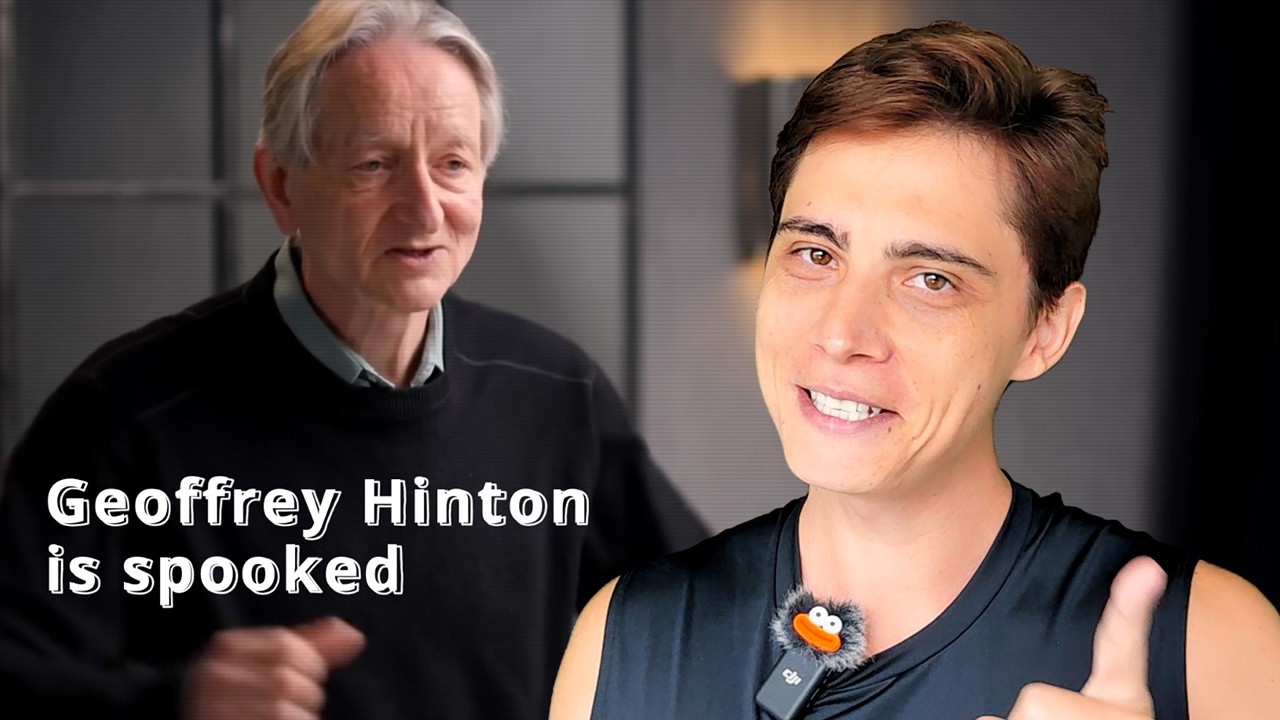
Also, I was watching this guy on YouTube today and a Twitter (I think) quote popped and the avatar looked familiar and I realized it was YOU! Were you aware of this? It’s at 4:31.

1 Like

I mean, this is really not sustainable.. At this point when I see a new model I simply ignore it.

5 Likes

Prevalent even in third-world countries. Heck I’d even assume globally.

For sure, I wouldn’t have thought otherwise.
















